
BDS Admission Through NEET: Counselling, Colleges & Seat Options
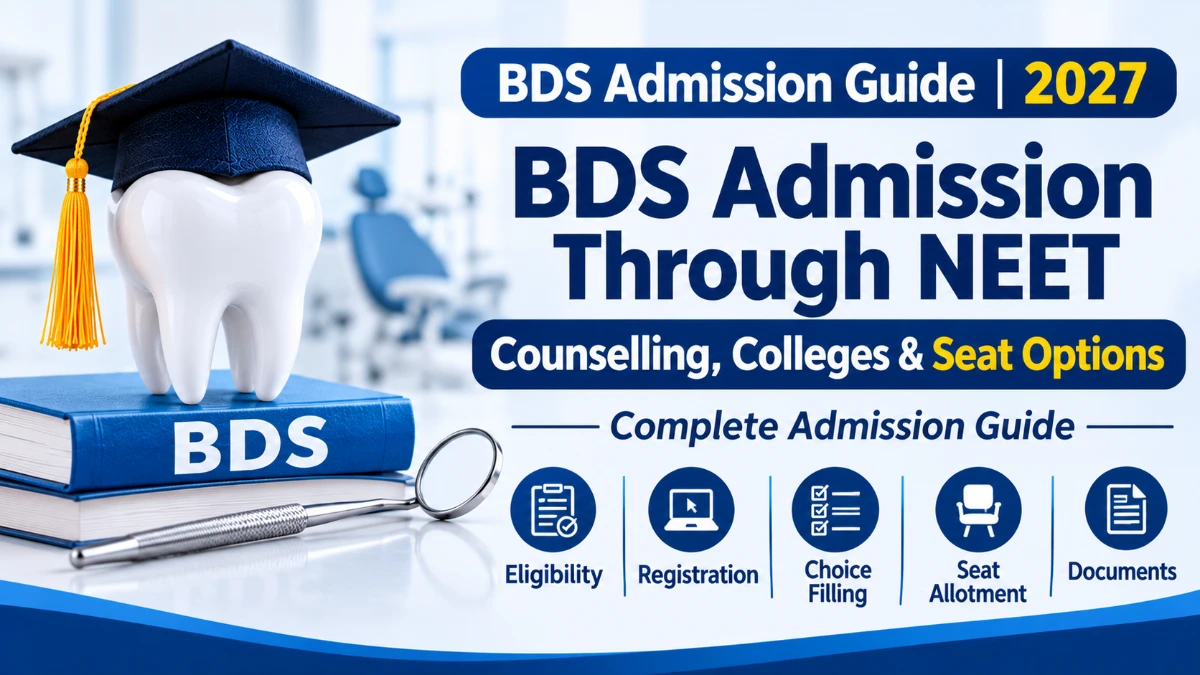
BDS Admission Through NEET: Counselling, Colleges & Seat Options
Planning to pursue dentistry after Class 12? Understand BDS eligibility, NEET counselling, government and private dental colleges, seat quotas and the steps involved in getting admission.
BDS, or Bachelor of Dental Surgery, is an undergraduate course for students who want to build a career in dentistry. Admission to BDS courses in India is based on NEET-UG, followed by counselling through the relevant authority. However, qualifying for NEET is only the first step. Candidates must also register for the correct counselling process, check their eligibility for different seat categories and complete the admission formalities within the prescribed timeline.
1. What Is BDS?
BDS stands for Bachelor of Dental Surgery. It is an undergraduate dental course that prepares students to work in the field of oral and dental healthcare. The programme includes academic study and clinical training in areas related to dental health, diagnosis and treatment.
Students who complete BDS and meet the applicable registration requirements can pursue dental practice or explore further study and career options in the field.
2. Is NEET Compulsory for BDS Admission?
Yes. NEET-UG is the entrance examination used for admission to BDS courses in India. Candidates must qualify NEET and then participate in the counselling process applicable to the colleges and seats they wish to consider.
The National Testing Agency (NTA) conducts NEET-UG and declares the examination result. It does not allot dental college seats or conduct the admission counselling. Seat allotment is handled by MCC or the designated state counselling authority, depending on the seat category.
Important: A NEET scorecard alone does not confirm admission to a dental college. Candidates must complete the required counselling registration, choice filling, seat allotment and college reporting process.
3. Eligibility Criteria for BDS Admission
Candidates must meet the eligibility conditions prescribed for the relevant admission year. The main requirements generally include:
- Educational qualification: Candidates should have passed Class 12 or an equivalent qualifying examination with Physics, Chemistry, Biology/Biotechnology and English, subject to the applicable regulations.
- NEET qualification: Candidates must qualify NEET-UG for the admission year in which they are applying.
- Minimum age: Candidates must have completed 17 years of age by 31 December of the year of the NEET examination, as specified in the applicable bulletin.
- Category and domicile conditions: State quota seats may have additional domicile, category or other eligibility requirements. These conditions differ between states.
- Document verification: Candidates must provide valid academic, identity and category documents wherever applicable.
For the NEET-UG 2026 admission cycle, the qualifying percentile specified in the NTA bulletin was 50th percentile for General and General-EWS candidates, 40th percentile for SC, ST and OBC candidates, and 45th percentile for Unreserved and General-EWS PwBD candidates. The applicable qualifying criteria must always be checked in the bulletin for the candidate's own examination year.
4. BDS Counselling: MCC and State Counselling
After the NEET result, eligible candidates need to register for counselling. The counselling authority depends on the type of dental seat.
A. MCC Counselling
The Medical Counselling Committee (MCC), under the Directorate General of Health Services, conducts counselling for specified All India Quota and institutional seat categories. For BDS admission, MCC counselling includes:
- 15% All India Quota seats in participating state dental colleges.
- 100% BDS seats of Banaras Hindu University (BHU).
- Specified seats in central universities and institutions, including relevant seats at Aligarh Muslim University (AMU) and the Faculty of Dentistry at Jamia Millia Islamia.
- Applicable institutional or internal quota seats in participating institutions, subject to their eligibility rules.
- 100% seats in participating deemed universities, including applicable NRI quota seats.
- Specified ESIC dental seats under the applicable quota.
The exact participating institutions and seat categories should be checked in the MCC information bulletin and seat matrix for the relevant year.
B. State Counselling
State counselling authorities handle seats under the control of their respective state governments, universities and institutions. This generally includes state quota seats and applicable seats in government and private dental colleges.
State counselling rules can differ. Domicile requirements, reservation rules, eligibility conditions, registration procedures and seat categories must be checked in the official notification issued by the concerned state authority.
| Counselling Authority | Main Seat Categories | What Candidates Should Check |
|---|---|---|
| MCC | 15% AIQ seats, specified central and institutional seats, and deemed university seats | MCC registration, seat matrix, eligibility and counselling rules |
| State counselling authority | State quota seats and other seats assigned to the state authority | Domicile, state reservation, registration and college-specific conditions |
5. Seat Options for BDS Admission
BDS seats are available through different counselling categories. Understanding these options helps candidates decide where to register and which colleges to include in their choices.
Government Dental College Seats
Government dental colleges offer seats through the applicable All India Quota and state quota processes. Candidates should check the seat matrix, category-wise availability, state eligibility conditions and previous allotment trends before filling choices.
Private Dental College Seats
Private dental colleges may offer seats through state counselling or other counselling routes specified for the institution. The fee structure, seat category and admission conditions can vary from one college to another.
Before selecting a private college, candidates should verify its recognition and current admission status, the applicable fee details and the conditions mentioned in the official counselling documents.
Deemed University Seats
Deemed universities participate in MCC counselling for their applicable BDS seats. Some institutions may also have NRI quota seats. Candidates interested in these options should check the institution-wise seat matrix and fee details before adding choices.
NRI and Other Institutional Categories
Some institutions offer seats under NRI or other specified categories, subject to the rules applicable to that institution and counselling authority. Candidates claiming such categories may need additional documents. The exact requirements should be confirmed from the official notification before registration.
6. Step-by-Step BDS Admission Process Through NEET
The broad admission process generally follows these steps. The exact sequence, round structure and deadlines are announced separately for each admission year.
Step 1: Qualify NEET-UG
Appear for NEET-UG and meet the qualifying criteria prescribed for the relevant year.
Step 2: Check the Counselling Notifications
Review the MCC and relevant state counselling notifications to identify the authorities, seat categories and eligibility conditions that apply to you.
Step 3: Register for Counselling
Complete registration on the official counselling portal for the seat categories you want to consider. Registration for one counselling process does not automatically register you for every other process.
Step 4: Fill and Lock College Choices
Select colleges in your actual order of preference. Check the college, course, seat category, fee structure and eligibility conditions before locking your choices.
Step 5: Check the Seat Allotment Result
After the authority processes the choices and merit list, check the allotment result and download the allotment letter if a seat is assigned to you.
Step 6: Report to the Allotted College
Follow the reporting instructions within the given deadline. Carry the required original documents and pay the applicable admission fee as instructed by the college or counselling authority.
Step 7: Complete Admission Formalities
Complete document verification and any remaining formalities required by the allotted institution. Keep copies of your allotment letter, fee receipt and admission documents.
7. Documents Required for BDS Counselling
The document list may vary by counselling authority, state, category and institution. Candidates should follow the official checklist for their admission year. Commonly required documents may include:
- NEET-UG admit card
- NEET-UG scorecard or rank letter
- Class 10 marksheet or certificate as proof of date of birth
- Class 12 marksheet and passing certificate
- Valid photo identity proof
- Recent passport-size photographs
- Category certificate, if applicable
- Domicile or residence certificate, if required for state quota
- PwBD certificate, where applicable
- NRI or other supporting documents, if claiming a relevant seat category
- Allotment letter, when reporting to an allotted college
Keep both original documents and the required photocopies ready. Do not assume that a document accepted during registration will automatically be accepted during final verification.
8. How to Choose the Right BDS College
Getting a seat is important, but the college you choose will also shape your academic and clinical training. Compare colleges carefully instead of relying only on their names or advertised rankings.
- Recognition and approval: Verify the college's current recognition and admission status through the relevant official authority.
- Clinical exposure: Understand the clinical facilities, patient flow and practical training opportunities available to students.
- Fee structure: Check tuition fees and other charges from the official fee notification. Do not rely only on verbal estimates.
- Hospital facilities: Review the attached dental hospital, clinical departments and available facilities.
- Location and accommodation: Consider travel, hostel availability and the practical cost of living.
- College rules: Read the admission, refund, reporting and other institutional policies before accepting a seat.
Do not choose a college based only on a low fee or an advertised admission claim. Verify the college's current status, seat availability and fee details through official sources before making a decision.
9. Common Mistakes to Avoid During BDS Counselling
- Registering for MCC but missing the separate state counselling registration.
- Assuming that qualifying NEET guarantees a BDS seat.
- Filling college choices without checking the seat category and eligibility conditions.
- Ignoring the official fee structure and additional charges.
- Entering incorrect details or uploading invalid documents.
- Missing choice-locking, reporting or payment deadlines.
- Accepting admission information from unofficial sources without checking the counselling authority's notice.
- Ignoring the rules for resignation, upgradation or participation in later rounds.
Every counselling round can have different participation and exit rules. Read the current year's counselling scheme before deciding whether to accept, upgrade, resign or participate in another round.
10. Frequently Asked Questions About BDS Admission
1. Can I get BDS admission without NEET?
No. NEET-UG qualification is required for BDS admission in India. Candidates must also complete the counselling and admission process applicable to their chosen seats.
2. Is BDS counselling conducted by MCC?
MCC conducts counselling for specified BDS seat categories, including 15% All India Quota seats, participating deemed university seats and certain central or institutional seats. State counselling authorities handle seats under their respective control.
3. Can I apply for both MCC and state counselling?
Candidates may be eligible to participate in more than one counselling process, depending on the applicable rules. However, each authority has a separate registration process, eligibility conditions and deadlines. Check both official notifications.
4. Are private dental colleges included in BDS counselling?
Yes. Private dental college seats are filled through the counselling routes specified for the respective state or institution. The exact seat categories and admission rules depend on the applicable counselling authority.
5. Does MCC conduct counselling for deemed university BDS seats?
Yes. MCC conducts counselling for 100% of the applicable seats in participating deemed universities, including the relevant NRI quota seats. Candidates should check the current seat matrix and eligibility conditions.
6. Does domicile matter for BDS admission?
Domicile can matter for state quota seats. The rules differ between states, so candidates should check the domicile and eligibility requirements in the relevant state counselling notification.
7. Does qualifying NEET guarantee a government BDS seat?
No. Qualifying NEET makes a candidate eligible to participate in counselling, subject to other conditions. A seat depends on factors such as NEET rank, category, seat availability, preferences and the applicable counselling rules.
8. Where can I check the official BDS seat matrix?
Check the MCC website for seats under MCC counselling and the official state counselling portal for state-controlled seats. Use the seat matrix released for the relevant admission year rather than relying on old lists.
Final Thoughts
BDS admission through NEET involves more than checking your score. You need to understand the available seat categories, register with the correct counselling authorities, fill choices carefully and complete admission formalities on time. Before making a final college decision, verify the current seat matrix, eligibility rules, fee structure and recognition status from official sources.
Need Help With BDS Counselling?
Understanding counselling options and choosing colleges can take time. Dream Careers can help you understand the admission process and plan your next steps.
Contact Dream Careers for BDS admission counselling assistance.
Contact Dream Careers
Phone: +91 95222 21191 / +91 95222 21192
Email: help@dreamcareers.co.in
Website: https://dreamcareers.co.in/
Services: Explore Dream Careers Services
Official Sources and References
- National Testing Agency – NEET-UG
- NEET-UG 2026 Information Bulletin
- Medical Counselling Committee – UG Medical Counselling
- MCC – Counselling and Admissions
Note: Counselling schedules, seat matrices, eligibility conditions and admission rules may change each year. Always refer to the latest official notifications issued by NTA, MCC and the concerned state counselling authority.